Always Prepared, the casual approach to session prep for Blades in the Dark
A lot of people will refer to Blades in the Dark as a "zero-prep" or "no-prep" game but that's not quite right. What these people really mean is that in comparison to more traditional RPGs, there is very little you need to put in effort to prepare aside from coming up with ideas.
In Blades in the Dark, a description is playable content. You never need to prepare a statblock to represent an enemy, or memorize what a list of spells do. You just have to focus on having a brain loaded with inspiration that you are excited to bring to the table, and have enough ideas in your quiver that you don't feel flat-footed when your players decide to do something unexpected.

The following describes the steps I take to prepare for my Blades sessions, and I hope this can help you too.
Feed Your Inspiration
The most important thing is to give your brain some fresh ideas to work with, or remind yourself of old ideas you've wanted to use but put aside and forgot.
Refresh Your Touchstones
Watch some of the touchstone films and TV shows, play some games, read some books. If you haven't already, check the list of touchstone inspirations in the rulebook, and delve into some of the media that inspired John Harper in writing Blades.
In addition to the ones in the book, I recommend these ones:
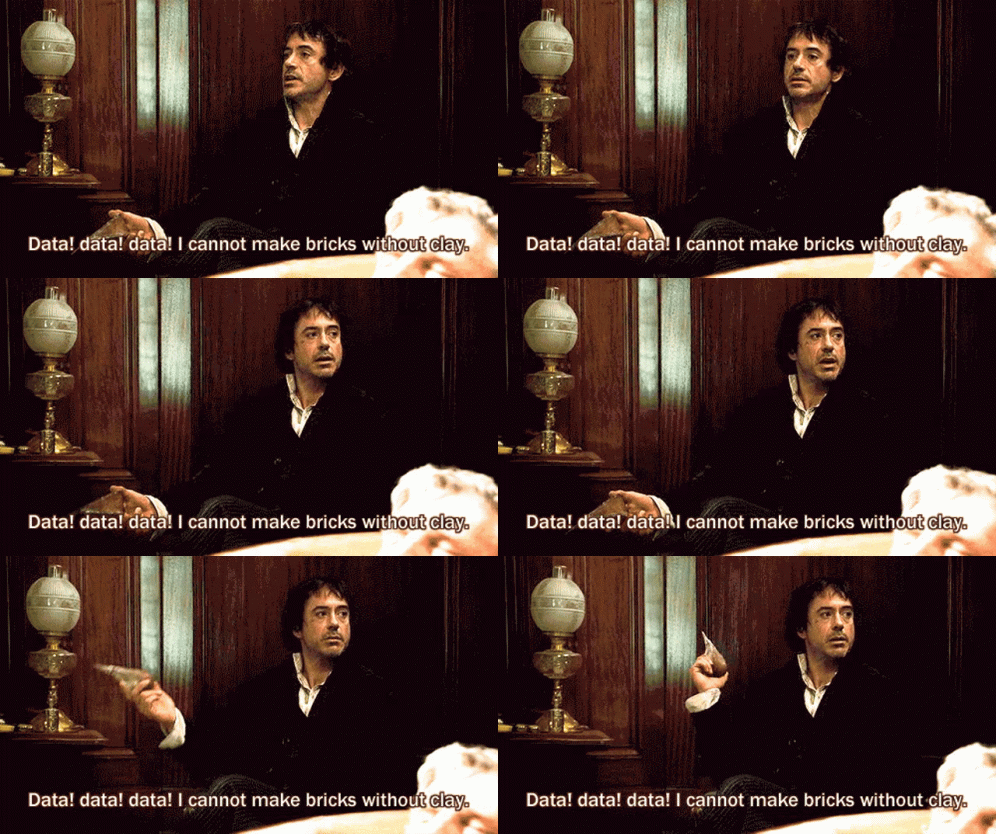
- Guy Ritchie's Sherlock Holmes movies
- Penny Dreadful (tv series)
- Ripper Street (tv series)
- The Frankenstein Chronicles (tv series)
- Steven Soderbergh's movies Ocean's 11, 12, and 13
Immerse yourself in the touchstones and take note of any particular scenes, props, cinematic techniques, character archetypes, or lines you would like to feature. Steal liberally! It's your game at your table, it doesn't matter if you lift characters out of existing stories. Your players probably won't realize, and even if they do it means you share the touchstones and they understand the archetypes and tropes you're borrowing and they can help you evoke them.
Listen to a Theme Playlist
Either spend some time collecting parts of soundtracks from your touchstone media, or go search around and you’ll find plenty of other playlists that other people have set up on Spotify and other music services.

Here are some of mine:
- Blades in the Dark
- Vices & Indulgence
- Montages & Moments
- Weird & Arcane
- Scores & Action
- Downtime & Planning
Build a Moodboard
Gather some art references that help convey the mood you’re going for. Pick up portraits to help you get into the mindset of a new character. Look for references for elements of a location you may not have thought of yourself.
Pinterest is great for this. Here is one of my Pinterest boards you can use as a starting point:
Ask Questions
You want your players to be invested in the story, and if you can encourage their investment they will feel more comfortable pushing the story forward on their own.
Ask your players if they have any characters or moments or tropes from the touchstone media they would like to play out in the game.
Ask them what previous story lines the players would like to follow up on. Ask them what NPCs they would like to meet again. Ask them what types of scores they would like to experience before retiring their character.
At the end of every session, after doing XP, ask the players what their ambitions are for the next session.
Brainstorm a Word Cloud
As you go through the above, take note of the things that elicit an emotional response in you: Is there a character in a show you think really fits Doskvol? Make a note. Is there a building in a photo you found on pinterest that you want to explore? Make a note.
Take everything and make a loose cloud of words, like adjectives to describe scenes, or short phrases to express specific moments or challenges, props and locations you would like to feature, sounds and smells of those locales, names and mannerisms of NPCs, etc.
You’re not going to use all of these, but when you’re in the swing of running things, pull the first thing that comes to mind out of the word cloud.
If you don’t end up using everything in the word cloud, re-use what’s appropriate for future scores and scenes.
Outline a Score
Mechanical Requirements
Game mechanically, there are a couple of things you need to set up that the game needs in order to hook the score into all of the relevant mechanics. You don’t need to have all of these decided going into the session, but it helps to have at least two decided and some flexible ideas for the other two:
Target. The most straightforward approach is to have every target be a faction. Everything can be traced to a faction one way or another. If you have a strong idea that doesn’t fit a particular faction, either make a new faction or use the general district attributes.
Client. Again, the most straightforward approach is to have this be a crew contact or someone working for a faction. Alternatively, make up a new character and have an existing contact introduce them. Or introduce a named NPC from a faction you want to feature.
Location. Whose turf is it? Is it hostile territory? What are the district traits? What’s an idea for a place that sparks your inspiration?
Reward. What’s the crew’s benefit? How much coin in payout? Any claims or upgrades they can gain from this score?
The Opportunity
Summarize the core crime.
“Make sure Lord Rowan dies.”
“Rob the bank!”
“Intercept the shipment of spirit bottles.”
The Hooks
How does this connect to the greater fiction? Are there character arcs or metaplot development that can lend context to this score?
How will you expose this score to the crew inside the fiction? Will they be approached by a client, or have to sniff around a bit?
“Make sure Lord Rowan dies before casting the deciding ballot on the nationalization of the Leviathan Hunter fleets.”
“Rob the bank before the Wraiths to prove that you’re the best burglars in the city!”
“Esme heard some Railjacks say the Spirit Wardens are camped out at the rail station to make sure nobody incercepts the shipment of spirit bottles.”
Ways to Approach
Think of one or two approaches (Assault, Deception, Social, etc), and how those different angles may alter the job.

How is robbing a bank in a brazen assault different from gaining access by using a false identity and talking the manager into letting you into the vault?
Pitch one approach as the initial opportunity and have an NPC propose this plan to the players, and then let the crew decide if it’s a solid plan or if it needs a different approach. The crew has an approach type they get bonuses to - don’t always suggest this approach. If they want the bonus they should have to work for it and set up their own approach.
The Danger
What is the actual struggle?
What hostile forces are arranged against the crew? How does that express itself?
What are the potential Initial Situations after the Engagement roll?
If the players are robbing a bank, is the Initial Position them entering the bank, or them trying to breach the vault, or them escaping the Bluecoats with crates of coin? This will depend on the approach the players choose and how well the engagement roll goes - but always keep in mind that you can drop the players in medias res and they can fill in what happened before.
What dangerous scenes can you think of in addition to the opposing force? What possible environmental hazards could you throw at the players to make their actions more perilous? What interesting twists and developments can you put on action scenes so it’s not just beating clocks? A running skirmish along the rooftops is much more thrilling than an alleyway brawl.
Preparing Adversaries and NPCs
Take Stock of Clocks
Check in on the faction clocks and get a sense of which factions are active and may have an interest in what the crew is getting up to. Especially look for what factions that are hostile to each other are up to - if one of them has a connection to the score, the other might get involved as well.
If you have faction clocks that are nearing completion but not quite done, have those factions look for crews to hire to get those last wedges in.
Review other open clocks on the table. Any lingering consequences you can bring into this session?
Use Named Characters
As Blades is meant to run with a flavor of film or television, don’t be shy about putting prominent NPCs on the screen and having them recurring. The stylized drama is enhanced when named characters are important and unimportant characters go unnamed.
The underworld is a small society where everybody knows each other, so tensions will be much higher if the crew runs into the boss or second-in-command of a faction than if they run into some random lieutenant you just made up.

Similarly: have the PCs’ friends and contacts and even rivals or leaders from other factions approach the crew with leads on scores, and leave part of the plan for the players to fill out.
Reinforce or Subvert
Your players are building their characters by leaning into specific tropes: the muscle, the sneak, the smooth-talker, etc.
Decide whether to reinforce or subvert these specialisms of the scoundrels. Your players have built their specialized characters because they want to see them be good at their special thing, but they've also set themselves up for a struggle if there's a challenge that is specifically at odds with their skillset.

Does the group have a smooth-talker who can slide past anyone willing to listen to their silvery tongue? Give him an opportunity to talk his way past a challenge - or - Put him in a fight he can't talk his way out of.
Do they have an unkillable fighting machine? Give him something fun to fight as a setpiece action scene - or - Put him in a situation he can’t solve with brute force.
Set Relative Magnitude
Since these games don’t use stats for tangling with enemies, you never have to worry about preparing any specific mechanical depth to the opposition. Instead, you can focus on the relative challenge against the players.
Picture a scene with the players against an opposing enemy or group in the upcoming session, and consider the dominant factors:
- Is one side going to outnumber the other?
- Is one side bringing to bear a particular advantage?
- Is one side targeting a specific weakness?
- Does one side have better training or equipment?
- Is one side particularly capable of dealing with this?
And consider how these factors would impact position and effect in any given moment. With this in mind, you can develop some idea if whether you’ll want to have a couple or a ton of guards to set difficulty, for example.
Expert Moves
Really high-tier or high-threat characters can be such terrible opponents that they inflict consequences on the players at the GM’s discretion.
Decide if you’re going to feature an expert in the score. If they’re going to be a tough challenge, dealing with them might be the majority of the score. You may want to jot down some rough ideas for "moves" that the expert NPC can pull to surprise the players, and decide if it'll mean putting the players in a dangerous situation they have to take action to get out of, or if it'll mean directly inflicting consequences on the players that they must resist.

Execute Before You Finish
Develop on the things above, make some notes, but don’t do any more work. Don’t even whittle down the possibilities. The Bank Heist might pay coin, or it might have an opportunity to steal the deed to a Claim. The bank might be owned by the Hive or it might be legit. There might be supernatural defenses or it might be entirely mundane. Keep things multiple choice.
Then, when you drop the opportunity into the session and the players start engaging with it and asking questions - only then do you decide what’s true and what’s not. Are the players seemingly more interested in getting a claim than you had anticipated? Good thing you had an idea for how to gain a claim from this next score, eh?
The more the players Gather Info, the more you collapse the quantum states until you have a shared truth at the table. Any questions the players didn’t answer, you just pick whichever truth you think would be most fun to play out.
Engage
Walk through the Engagement Roll questions with the players.
If your players are stalling trying to prep for increasingly outlandish potential issues, you may need to force them into the engagement roll but the beautiful thing is that it can serve as a checklist for the whole group to get the advantages they want without spinning their wheels. For example, the players will only get +1D for "a friend or contact assisting with the score" but they won't get +2D for two contacts helping. So if they're obsessively chatting to NPC after NPC to get advantages on the score, remind them that they will only get the bonus once. Any further contingencies they can call in through flashbacks if they become relevant.
Squeezing the group through the engagement can prompt a few last-minute Gather Info efforts and set a few more facts in stone. It also lets you telegraph if you have decided a truth the players haven’t exposed (a rival interfering, enemy being prepared against the crew’s approach, etc), but you ought to expose this in the Initial Position after the roll.
After the players make the engagement roll, take a break. Take 5-15 minutes to do some final outlining and grabbing things from the word cloud.
Then you’re ready to jump into it. Give a lavish description of the approach, pulling inspiration from the word cloud, and drop the players into the initial position they rolled.
And you’re off!
Member discussion